Wednesday, July 29, 2009

Don't tell her this, but until today, I'd never heard of Kara Swisher.

I followed a link to one of her columns on the site All Things Digital from MediaBistro's daily digest. First I noticed that there are two names on the site: hers, and Walt Mossberg's. Secondly, I found, prominently displayed on the left, a link to her Ethics Statement. Further piquing my interest, the tag before the jump said, "This is probably more than most of you want to know, but...."

Ah, rejoice! I want to know more than most of us want to know! Tell me more!

Swisher, who is a technology writer, proceeded to disclose her relationship with an executive at Google (her wife, which led to a brief acknowledgement of disagreement with California's Proposition 8, effectively repealing same-sex marriage), and the way she manages any potential impact from that relationship. She stated, basically, that she does not accept money from anyone she covers in any way. She referenced her investments and explained that the funds are managed in such a way that while it is possible at any given time that she might own shares of stock in a tech company, she is not aware of those individual purchases.

Essentially, Swisher invaded her own privacy and stated for the records all the things some believe should be assumed. It's not entirely what she said, but that she said it at all.

Like the taboo against discussing salaries (the continued existence of which must be adding just a little more spin to Marx's turns in his grave), I've always felt it's a little silly to take offense at obvious ethical or conflict-of-interest charges that might fall short of the legal line. It might be naive of me, but if one is in the business of providing information others depend on, disclosure of relationships, financial or otherwise, that might affect one's viewpoint, and sharing a few details about how those potentialities will be managed, is both good business and good ethics. No one in the media is presumed innocent until proven guilty any more, even - sometimes especially - its producers. Transparency is vital to the integrity of news.

Is this something that should be business as usual, expected by the public, for anyone proclaiming any level of accuracy and objectivity - a practical, necessary sign of good integrity? Or is it a dangerous precedent for the invasion of privacy and a smear against names wh ich have not yet been attacked?

Wednesday, July 15, 2009

Some quotes about the media....

Trying to determine what is going on in the world by reading newspapers is like trying to tell the time by watching the second hand of a clock. -- Ben Hecht

Journalism consists largely in saying "Lord Jones died" to people who never knew Lord Jones was alive. -- G. K. Chesterton

[You reporters] should have printed what he meant, not what he said. -- Earl Bush, press aide to Richard Daley

Unfortunately, the media have trouble distinguishing between real science and propaganda cross-dressed as science. -- Linda Bowles, columnist

Its failings notwithstanding, there is much to be said in favor of journalism in that by giving us the opinion of the uneducated, it keeps us in touch with the ignorance of the community. -- Oscar Wilde

The difference between literature and journalism is that journalism is unreadable and literature is not read. -- Oscar Wilde

The public have an insatiable curiosity to know everything. Except what is worth knowing. Journalism, conscious of this, and having tradesman-like habits, supplies their demands. -- Oscar Wilde

The good people sleep much better at night than the bad people. Of course, the bad people enjoy the waking hours much more. -- Woody Allen

A little inaccuracy sometimes saves a ton of explanation. - H. H. Munro (Saki)

Tuesday, July 14, 2009

International journalism...sorta

In honor of Bastille Day, an "important time to recall justice and equity," here is a look at some current info on French journalism....

France has three major dailies: Le Monde, Le Figaro, and Libération. Le Monde, which means "The World," is considered the French newspaper of record. It has existed for less than a century, having taken over the format of Le Temps ("The Time") after World War II at the request of Charles de Gaulle. Le Temps was suspended November 30, 1942, after accusations of collaboration with the German occupation. Le Monde went into print on November 19, 1944.

Le Figaro was started as a satirical weekly newspaper in 1826 and evolved into a daily in 1866. It is a conservative paper.

Libération. also known as Libé, is the youngest, founded in 1973 by Sartre (the father of existentialism. And in an eerie domestic arrangement Simone de Beauvoir called "The Family," but that's beside the point). It was originally a leftist paper - where all staff from the editor to the janitor received the same salary - but has moved more to the center-left (and a "normal" pay scale). It's gone through quite a shakeup in the last few years, as it needed money, took on an investor (Edouard Rothschild) who claimed he wouldn't interfere, then said he wouldn't invest more money unless the editor, Serge July (also a co-founder) and Louis Dreyfus (the "directeur général") resigned. A total of close to 150 people have resigned, been laid off, or dismissed since the beginning of Rothschild's involvement.

There are many comparisons between French and American journalism out there. Still an initiate to the world of journalism myself, I was a little surprised to find that comparative journalism is already a sub-field. One practitioner, Rodney Benson, said in an interview with PressThink, " What’s different then is that the journalistic voice in the French press is more overt."

The French press tends to be opinionated and editorial, but Benson praises its mix of "context, interpretation, and judgment" within its dailies - more affordable and widely read than the U.S. opnion magazines - as a vehicle to foster a more truly national debate.

This comparison doesn't go into great depth, but it's a thorough and intriguing analysis of the differences between one American and one French journalist, covering the same event in Russia, who both won their nations' highest prizes (the Pulitzer and the Prix Albert Londres).

Wednesday, July 08, 2009

Contacts for cash at WaPo?

Proving the relevancy of the academic discipline I'm inventing, a scandal over WaPo (as reported by Truthout.org) has blown up over the last week.

According to a Thursday, July 2nd, Politico article (Washington Post cancels lobbyist event amid uproar), a health lobbyist who received a flier about a fundraising salon provided the flier to journalists because he felt it was a conflict of interest.

The article reports that the flier read, in part: "Underwriting Opportunity: An evening with the right people can alter the debate," says the one-page flier. "Underwrite and participate in this intimate and exclusive Washington Post Salon, an off-the-record dinner and discussion at the home of CEO and Publisher Katharine Weymouth. ... Bring your organization’s CEO or executive director literally to the table. Interact with key Obama administration and congressional leaders."

Obviously, an instant and major objection is the phrasing "alter the debate." While it's literally true, language like "the right people," "alter the debate," "intimate and exclusive," and finally "$250,000" - the price tag - imply influence peddling, not merely discussion and information sharing.

That aside, is this merely a PR nightmare, or an actual ethics explosion?

In her apology, Weymouth writes "I do believe there is a legitimate way to hold such events."

The Truthout.org article linked above reports that Rosabeth Moss Kanter, a professor at Harvard Business School, disagrees. She argues: "The bottom line, so to speak, is not what was said on the fliers about paying big bucks and getting a seat at Weymouth's dinner table. It is that the fliers were honest about the nature of the offering: contacts for cash."

It seems to boil down to the question of whether or not the event is on the record. Because this dinner would not be, it implied that the journalists of the Washington Post were available for purchase - for officials to pick their brains and influence them without direct reportage, and for lobbyists to use reporters to get to officials. Obviously, this violates the ideal of independent reporting.

Weymouth outlines what she sees as the ethically correct approach: "If our reporters were to participate, there would be no limits on what they could ask. They would have full access to participants and be able to use any information or ideas to further their knowledge and understanding of any issues under discussion. They would not be asked to invite other participants and would serve only as moderators."

The opposing view is that any paid off-the-record access compromises journalistic integrity, because it has journalists entering into a financial arrangement with the people that they are covering.

Kanter, quoted above, said, "Let's hope that the Chinese wall between the news side and the business side doesn't crumble under current intense financial pressure as the industry transforms."

I've tended to argue the opposite - I want it to crumble. I think the mitigated, residual, but influential leakage of business concerns still affects the news as it is reported. I believe that a large and powerful news organization such as the Washington Post is better able to insulate itself from those effects, but that when spillover does happen, it reaches further; and that a smaller organization is impacted by more limited concerns but more likely to be forced to consider them.

I agree with a statement from David Bradley, the owner of Atlantic Media, in an internal memo (as reported by MediaBistro's Fishbowl blog): "The imperative, as I see it, is to rebuild journalism on different financial pillars."

In addition to being succinct, this statement is interesting because of what Atlantic Media does. For six years, the company has hosted off-the-record dinners for a price. The memo quoted was written in response to the WaPo scandal, discussing the issues as he saw them: secrecy, motives, the issue of off-the-record, editorial staff involvement and marketing materials.

He wrote, "As the whole of our enterprise surely knows, the economic foundation beneath journalism is falling away. Ten years ago, 55% of The Atlantic's revenues derived from print advertising. Today, that figure is 29%. I think I will be more comfortable, still, when that dependence falls below 20%. The imperative, as I see it, is to rebuild journalism on different financial pillars. One of them, and not inconsequential to us, is events of all types."

I want it to be possible for people with money to give it to journalists. I really do. And I think that sponsored dinners, if handled correctly, are no more influential than running advertising in news pages...and maybe less. How, though, do we ensure that they are "handled correctly" when the doors are closed?

An aside: a critical Examiner.com opinion piece seems to me to have jumped on the bandwagon facing the wrong way, perceiving the victims to be "the citizens of the District of Columbia," as the planned event did not discuss their civic issues. WaPo has significant national concerns as well as local, and if the Examiner would like to see a better approach to those local civic issues, that's fine - but it has nothing to do with this planned dinner. A significant problem when addressing ethics concerns is exploding the ground. Let's deal with one issue at a time, people.

Sunday, July 5th, Washington Post: Publisher Katharine Weymouth writes letter of apology to readers
Sunday, July 5th, Washington Post: Post Publisher acknowledges mistakes
Monday, July 6th, Politico: WaPo launches internal review

Monday, July 06, 2009

The cradle of the nation

The Fourth of July has always been a quietly powerful holiday for me, with various personal meanings. This year, it took on a new meaning - or more accurately, all the meaning it holds for me coalesced, breaking like a wave inside me as I sat on the huge stone block where the First Amendment is engraved near Constitution Hall in Philadelphia.

It started innocently: a friend mentioned he had to drive someone to the airport on the Fourth, and that he was thinking of going into Philadelphia afterwards.

"You know, because that's where it all started and everything," said my friend, who will, after spending two-thirds of his life in the country with a green card, finally become a citizen this year.

"Ooh!" I said. "That sounds like fun! I've never done that."

Despite having moved to Pennsylvania almost eight years ago (the longest I have ever stayed in one state), and despite visiting it often even before that, I've never actually gone to the city for the Fourth.

My father grew up in the Philadelphia suburbs and because of that, and his family, I've been coming back to this city for my entire life. I clearly remember a trip around age 7 during which I stood inside the Liberty Bell and traced the crack with my finger. Now, I've been told that no one's been allowed to touch the Bell for decades, so maybe it was a full-size replica, or maybe my tour guide broke the rules big time. Or maybe I had a really, really overactive imagination.

But I went to see the Bell on Saturday, and for the first time read the plaque on the outside of the building. A loudspeaker was delivering the message, and it finished as I read. A little kid darted up to the other side of the window where the plaque is and pressed a button, and a delivery in Spanish started. I was unexpectedly and deeply moved.

The trip started as a lark, but as we were taking our first break from walking, sitting on a bench outside a Quaker meetinghouse, four men in extremely realistic colonial costume walked down the path. I smiled at them, startled, then recognized one of them - Benjamin Franklin. I mean, they were all in great costumes, but this man, body, face, and hair, just looked so much like Ben Franklin that it was like he had stepped out of the past.

Now, Ben Franklin is kind of my hero. He started with nothing to speak of. He showed up in Philadelphia as a starving, broke runaway. He had a year of formal schooling and a few years' experience in a print shop. He was a printer, an entrepreneur, an editor, and a community organizer. He started a hospital, a library, a fire company, a university, an insurance company, and a society of learning - most of these being innovative social contributions, the first of their kinds in the country, or at least in Philadelphia. He had great talent with science as well, which he turned to increasingly after about the age of 40. He refused to take out a patent for the Franklin stove, he said he would never run for public office, although he would take any office offered him, and he was already 50 years old when he started his career in diplomacy. Originally loyal to England, he thought of moving there permanently, but as his knowledge of corruption in the country grew, he started wondering if America should break away.

He was one of the original investigative reporters, discovering letters from a two-faced politician and sending them to the colonies to be published (in the Hutchinson affair). He contributed much or most of the thinking behind the Declaration of Independence. He was seventy when he signed it.

He was the Ambassador to France, where he helped pave the way for the French Revolution. Always ahead of himself, by the time it actually occurred, he was already back in America, writing an anti-slavery treatise.

My father assigned his autobiography to me when I was being home schooled, and he's fascinated me ever since. Any flaws aside, I think he is one of the most remarkable men ever to have lived, with one of the most remarkable minds in the history of humanity.

Seeing my childhood hero in the flesh - so to speak - gave me a sense of wonder that underlined my feeling of connection to Philadelphia, and to Independence Day. Later I found the actor outside Independence Hall and got a picture with him, which made me feel incredibly obnoxious and touristy.

Independence Day represents everything that means the most to me - liberty, equality, freedom, true justice. It's the meaning of my life, really. It's why I'm here - to understand the meaning of those ideals, to protect people who are threatened with losing them, and to help them learn to understand them and protect them in turn. I'm grateful to the people who have died for them, but I want to live for them.

Tuesday, June 30, 2009

In capitalist America, business buys you!

In accepting the Lawrence Minard Editor Award, a Loeb award, Ingrassia, the business and financial editor at the New York Times, said that the current era hearkens "back to the 1930's, not because we're in a depression, but because it's increasingly incumbent on the press to be the watchdog."
This is yet another connection between news and the study of ethics. For every law, there has to be a regulatory agency to ensure it is enforced. And regulatory agencies can't catch everything. The news is the public's guard, or should be. It not only ferrets out some wrongdoing through investigative journalism, but publicizes the consequences.
It's true that publicity can hurt; for instance, it can increase a kidnap victim's value, which was part of the motive in suppressing the news about David Rohde. It can also encourage copycat crimes. However, Madoff's sentence of 150 years, for example, lets potential white collar criminals know what they might be able to expect.
We need the news. And we need to trust our news source. Ethics is a necessary part of journalism, and we must find a way to operate our business, before it goes any further in operating us.

Monday, June 29, 2009

An amusing interlude.

I asked the copy editors (Bill and Bob) about doing some editing, whereby I shall increase my facility with the incomprehensible style of AP, and Bob gave me a homework assignment: Twain's essay, Fenimore Cooper's Literary Offenses.

"This," said the copy editors, as dislike in temperament as Twain and - and - well, Natty Bumppo, "this is what to keep in mind as you edit."

It's an amusing little ditty, the essay is, but my favorite part is the end (I think Twain might approve). Twain compares Fenimore Cooper's feeling for words to an "ear for music," an excellent idea in its own right - why is it that we can say someone has a good ear, but a sense for what word is right and what word is not is so often dismissed and discounted as mere "style?"

(To clarify, Fenimore Cooper's "ear" is rather deaf, in Twain's estimation.)

That small plaint aside, poor Twain! Given that he wrote about Fenimore Cooper,

"Now I feel sure, deep down in my heart, that Cooper wrote about the poorest English that exists in our language, and that the English of "Deerslayer" is the very worst that even Cooper ever wrote."

...well, he must be spinning in his well-decayed grave if any broadcasts from current publishing reach him there.

He calls "Deerslayer" a "literary delirium tremens," and writes,

"A work of art? It has no invention; it has no order, system, sequence, or result; it has no lifelikeness, no thrill, no stir, no seeming of reality; its characters are confusedly drawn, and by their acts and words they prove that they are not the sort of people the author claims that they are; its humor is pathetic; its pathos is funny; its conversations are -- oh! indescribable; its love-scenes odious; its English a crime against the language."

If only I could read a newspaper edited by Twain.

Because only Salon comes out with lines like this:

"That's the ultimate irony, no? That in the midst of remarkable and unprecedented change, in the midst of the greatest stories to happen all century, we are paralyzed by some changes in the delivery system."

But wait, there's more:

"(I)t is not just the delivery system; paper itself is a kind of message; it tells us that information is permanent, whereas the Net tells us that information is in motion.

"So the print journalism curriculum may have taught, incorrectly -- because it is taught by ox-cart drivers -- that information is permanent, not that it is in motion....

"We must ask: If information is in motion, does that make it more or less true? That depends on whether you believe the world is in motion. Obviously the world is in motion. So information must be in motion as well."
The swine flu. Iran. Michael Jackson. What do they have in common? Twitter.

The swelling wave of tweets has demonstrated something very concisely (as tweets are required to do): the public no longer depends on journalists to break the news, but to help them filter and understand it.

Yes, time still matters. But the source to publish stories with the most accuracy, breadth, and depth in the time they take will be the source the public will still go to even if they have to start prioritizing their source - i.e., if and when content becomes paid in some way.

So right now, timing matters - but it doesn't matter that much. Competition used to matter because it sold newspapers, and papers could get a story a whole day ahead of one another. Then TV outlets could get an edge by getting to the scene first. But when the difference is minutes instead of hours or days, and when users can surf from one site to another or even, hey, open all of them at once, the better coverage - the consistently better coverage - will begin to matter.

In an NYT article yesterday, Brian Stelter quoted Matthew Weaver, blogger for The Guardian, as saying, "When rallies and conflicts occur 'first the tweets come, then the pictures, then the YouTube videos, then the wires.'"

Sources are becoming citizen journalists, and vice versa. It's breaking news all the time - but it's not being broken by the major outlets anymore. However, they are still the venues the public trusts, and that makes all the difference.

Dealing with information that changes this quickly works because most bloggers - and news services - are transparent about what they know and what they don't.

The news environment has been sucked into the rumor mill, but that's not all bad - if reporters can strategize, rather than simply react.

Thursday, June 25, 2009

Over the last month, the scene from Minority Report where Tom Cruise enters a mall and holographic advertisements greet him personally has flashed through my mind at least once every few days. The first time I saw that, I was afraid. I could just imagine the invasion on my senses. To me, advertising is a distorting force that corrupts the logical functions of all who are regularly exposed to it. Advertising is one of the biggest reasons I don't own a TV.

Lately, watching the decline of print advertising venues, I've felt that it's still just a matter of time before holographs can whisper inside my head. Like a childhood fear, my phobia has lingered through the shrinking of newspapers and magazines alike, through my own arguments that media is not in a recession; media is in a revolution.

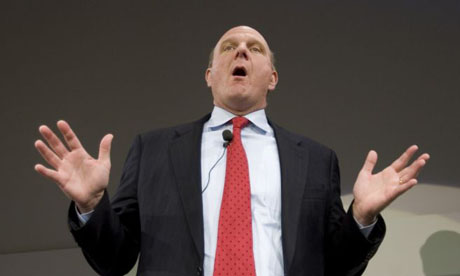
So I was relieved to read on the Guardian's Web site this morning that Steve Ballmer, Microsoft's chief executive, not only feels the same, but applies that logic to advertising as well. According to the article, he said "that the global advertising economy has been permanently 'reset' at a lower level, warning that media companies should not plan for revenues to bounce back to pre-recession levels."

Ahh, deliverance.

While I don't know exactly where the revenue for news will come from, I'm glad and hopeful when I think it won't be advertising. The advertising based business model is only slightly more ethical than outright campaign-style contributions from interested parties. It was never the best way for news to run - only the easiest. Go ahead and attach advertising to the fluff, the horoscopes and movie listings and recipes. But make sure the news is paid for by money with as few strings as possible.

Tuesday, June 23, 2009

To profit or - nonprofit?

We'll need a prophet.

Why do I feel so torn about this? Drum up a few billion-dollar endowments for the bigger papers, and a bunch with just a few million - hey, the poetry conference at the local college managed to come up with an endowment, surely newspapers can too! Nonprofit status would come with its own thorns, but grant writers wouldn't be any pricier than ad and sales staff. Writers would be under less pressure than ever, corporate-wise. Transparency, which is necessary to the brand of any paper and will only become more so, would be increased through the reporting methods required in nonprofits. It sounds like a fairly elegant solution.

Prima facie, I don't have concrete objections - I have an article sitting in my inbox to read and I will no doubt find some. But holding it in abeyance, for the moment, nonprofit sounds smart...but it feels sticky.

It seems like a step backward, and it feels like giving up. It raises a preliminary concern that something vital will go out of news, some competitive edge. Besides, I still think there's money to be made peddling information in the age of history in which it is more important than ever before. I also have the feeling that if news goes nonprofit, it will be a temporary solution; information is too valuable. Someone will find a way to sell it again. - On the other hand, if it's free to start with, what more are they going to offer?

On to that article: The Trouble with Non-Profit Journalism.

Jonathon Weber writes, "...We are held to the brutal discipline of the market, which is very unpleasant a lot of the time but I think is ultimately a healthy thing. For the core problem that non-profit journalism will never be able to solve properly is deciding what is worthy."

Ok, I'm listening....

"In a business, the customers ultimately decide what is worthy, for better and for worse. Managers at good companies can think for the long term and the greater good - and in fact there is clearly a market for thoughtful journalism - but as the VCs like to say, eventually the dogs have to eat the dog food. It keeps you honest. In a non-profit, either the board or the employees decide what is worthy - and why them?"

I don't get it.

I don't see what would change - right now, the editors and the publisher prioritize stories based on what falls within our coverage area, what will catch the most attention, what affects the most people. In that order, actually. I believe that model would persist - and in fact, with less pressure to sell sell sell, we might have fewer swine flu newsprint epidemics (did you know that we went to level 6, the highest level, on the WHO scale? No? Maybe that's because the story was over-hyped before and is under-hyped now. It's still a concern people. Just not a black and white and red all over, wear-a-face-mask type of concern.) and more depth about community budgets, instead of isolated murder stories that really only affect the perp and the victim and their families.

Weber is concerned about losing the fluff completely; without lifestyle pieces, recipes of the week, movie listings, comics, personal finance tips, et al, consumers might further lose interest, throwing off the model for sales contributions to the nonprofit budget. I say...meh. There is space for those things. They aren't difficult to produce. Weber questions if the foundation mission would allow for that. Well, why not? Write it in. That's a weak hypothetical problem.

He does grant that nonprofit support has a place, and that he himself is seeking funding for some projects. And I think that might be his greatest insight: nonprofit journalism may be most applicable on a project basis.

Still sticky, though.
On my mind today: business and journalism ethics, and David Rohde.

Funny thing is, I was thinking those were different topics - and they're not.

Bill Keller, NYT editor, made a judgment call not to print the news about Rohde. The issue: should the paper have printed the news because it's news, in order not to bow to terrorists, and/or because it would sell papers?

1. Newspapers have a responsibility to print the news. However, what about when news would do more harm than good - and who makes that call? I wrote an article in February about a former crime reporter who got a tip that a criminal was talking, ready to turn in the big guns. Law enforcement was trying to keep it quiet, pulling him out of jail to talk in the middle of the night, because they were afraid not only that evidence would be moved or destroyed in some way, but that their informant would be killed - or even that other people would die. Breaking the news that the guy was talking increased the risk.

But is that the journalist's responsibility? And should the decision of what news to share and what information to protect always be dictated by what would benefit the public? Remember - journalists don't exist to aid government, although they often can and often do when they can. A free press exists to be a thorn in the side of officialdom, proliferating transparency. Also, it can be hard to say what's best for the public, sometimes.

In Rohde's case, reporters who have worked on kidnapping cases apparently tend to agree that publicity escalates the situation and leads to violence. Reporting on a situation often "forces" perpetrators to act.

2. Of course, how far do we go to appease violent factions in order to keep those important to us safe? How far exactly does a policy of not negotiating with terrorists go? If the NYT was asked for ransom, should they have paid it?

Even further, is it a newspaper's responsibility to uphold governmental policy of not negotiating with terrorists? Or do they have the right to ransom their own if they want?

As for 3. - The bottom line would have said to print it, so the issue immediately becomes relevant to business ethics in that the immediate profit did not dictate the decision.

Thorny, sticky questions. I think there is no clear ground; that's what makes ethics so difficult. There are "rights" about the "wrong" decision(s) and vice versa. And I don't think a pro/con list takes care of it; every situation is specific.

In this situation, I think they did the right thing. The public could not have taken any action that would benefit the situation had the Times reported on it, while reporting could have significantly harmed Rohde.

What do you think?

Thursday, June 18, 2009

iPhone vs. iPod: Which is more useful? Which is more expensive, data-wise?

I think - and have thought for at least three years - that cell phones, music and video players, and portable computers (laptops, netbooks, what have you) will soon merge into the same device. Within ten years, and that's a generous range.

But in the meantime, I don't fully understand the various costs for data usage on web-capable phones and pocket pc's. Any feedback?
"The media needs to find its place in the new-media world. It will be needed. There were already concerns that the Iranian government was sending out disinformation on Twitter in Iran. Just as Twitter becomes an effective medium, it will surely be co-opted by evildoers and hucksters who can take advantage of its lack of filtering. There will be a need to curate the growing tsunami of information." -Larry Kramer

Whose motto is "Nothing sacred but the truth?" I read a reference to that the other day. Perhaps the truth is sacred, but like many sacred things, it wears many faces and is invariably interpreted on a thoroughly subjective basis.

And we can't say "Nothing but the facts," because the facts are out there. People don't read lists of data, and are often incapable of doing so due to time constraints or lack of ability to understand the format. What people need is collation, analysis, and fact-checking, compiled into readable narrative.

We need people who will do that, and we need a way to pay them. Is there a viable subscription model? I have a hunch that the subscription model that works will be related to a form of technology that has not yet caught on, either hardware or software based. It's not just that people won't pay for content (although there's truth to that); it's that they can't do it easily.

People are afraid of their financial information being stolen, or of being charged multiple times for the same service if they forget to cancel or if a mistake is made. They don't want to bother pulling out the credit card when they're comfy in their desk chairs, and typing in 16 digits plus expiration date. They don't want to deposit money in a special debit account; what if they need that money for something else?

We need a way for people to pay for content directly and securely from their credit and debit accounts. Micropayment needs to be a part of the model. We also need tiers of pay models that don't require consumers to pay five, ten, fifteen, fifty different sources for information. I don't want to give up surfing from NYTimes to WaPo. Aggregate services won't necessarily be the end result of this information transformation, but I do believe they will play a major role in the next wave.
My favorite twitter about PETA's response to Obama's fly swat:

"Any PETA members using antibiotics should be ashamed. Who's going to look out for these defenseless bacteria?!"-surye

Actually I'm a vegetarian and I don't usually kill bugs, but PETA. Come on. You're saving the ammo not used on deer to shoot yourself in the feet.

No flies were harmed in the creation of this post
.
Morning routine: walk in. Dump food on desk. Fill water bottle. ...Get advised to cater to business interests in an upcoming story?

I stopped off at an ed's desk about an email he, I, and two others were sent by a contact yesterday, about a workshop for seniors on re-selling property, through ebay and other means. He says to go ahead and check it out, then says "Oh - just to let you know, the business office gets kinda funky when we cover competing interests, like ways to sell things over the internet."

I thought I covered my raised hackles and urge to growl quite well as I tossed back with minimum sarcasm, "I think they missed that boat. About five years ago."

He chuckled unconvincingly.

News stories shouldn't be slanted by the business interests of their papers. Of course, as the resident idealistic realist, I get that without the business offices, I wouldn't be sitting at this pretty little desk with this pretty little flat panel typing these pretty little words. For a moment I considered exonerating my business-conscious bud, then I thought -

No! This is exactly what's wrong with the business of journalism. Effective journalism comprises reporting the facts. What kind of journalist would I be if I avoided reporting on ebay, craigslist, facebook, twitter, and the like just because they represent competition? The business of journalism is defeating the journalism business. We have to change the model.

To what? Well, I'm still working on that. According to the Knight Foundation, though, foundations are starting to play a bigger role.

Next question: Can foundations play a big enough role to support a viable industry? Not the existing industry, necessarily, but at least a satisfying future model?

Monday, June 01, 2009

Stories that caught my eye today:

Welcome to a dying industry, journalism grads

Excerpt: "[Journalists] are not part of an elite. We are part of the working class, which is exactly how journalists have seen themselves through most of American history - as working stiffs. We can be underpaid, we can be jerked around, we can be laid off arbitrarily - just like any autoworker or mechanic or hotel housekeeper or flight attendant.

But there is this difference: A laid-off autoworker doesn't go into his or her garage and assemble cars by hand. But we - journalists - we can't stop doing what we do.

As long as there is a story to be told, an injustice to be exposed, a mystery to be solved, we will find a way to do it. A recession won't stop us. A dying industry won't stop us. Even poverty won't stop us because we are all on a mission here."

With newspapers in terminal decline, what future for arts journalism?

Excerpt: "...[I]t is only a matter of time before someone puts the pieces back together again. The search for a hopeful future begins with the insight that although journalists and publications are suffering, readership is up by wide margins. More people than ever are reading and writing about art, thanks to the web.

The problem is not the scarcity or the quality of arts journalism (the latter has always been mixed), but that no one is paying for it—at least not yet. "

...

“'Society doesn’t need newspapers. What we need is journalism,' media analyst Clay Shirky observed in his blog recently. 'No one experiment is going to replace what we are now losing with the demise of news on paper,' he added, 'but over time, the collection of new experiments that do work might give us the journalism we need.'”

Time Warner CEO hints at online fees for magazines

Excerpt: "Like other publications, Time Warner's magazines — a group that includes Time, Fortune, People and Sports Illustrated — have been hurt by a steep decline in print advertising. Time Warner's publishing division suffered a 30 percent drop in ad revenue in the first quarter.

With little hope that online ad sales will ever compensate for the erosion on the print side, more publishers are drawing up plans to charge for access to Web sites that have been mostly free for the past decade. Newspaper industry executives met Thursday in Chicago to discuss the prospects."

In the sudden death financial rounds the journalism industry has been unwillingly entered in, it's been easy to forget that there are still journalists in the world who face losing more than their 401(k)s.

But we don't have far to lo0k to remind ourselves that journalists risk more than investments.

For one, this week a trial begins in North Korea for two journalists seized three months ago.

The AP reports that Laura Ling and Euna Lee, both Americans working for Al Gore's Current TV venture, face potential sentences in North Korea's labor camps, for reporting on women and children who were fleeing to China as refugees.

Today is also the birthday of an Egyptian poet whose most famous work shunted his son into exile, despite attempts to intervene by the organization Reporters without Borders. Naguib Surur wrote a stream-of-consciousness piece full of sexual imagery which he never attempted to publish, as it would never have made it past Egypt's censorship laws. Instead, the work circulated via audio cassette. In 2000, almost a quarter century after his young death, Surur's son posted the poem on a U.S. based Web site. The son ended up sentenced to a year in prison, and fled to Russia, where he has dual citizenship. He remains in exile.

Reporters without Borders was founded in France. Unsurprisingly, given the journalistic tradition in France, it started with an entirely different purpose than it ended up with - due to disagreements among its founders. This just in: no one shocked. Anyway, the organization states that it draws its mission from Article 19 of the 1948 Declaration of Human Rights, which states that all peoples have "the right to freedom of opinion and expression" as well as to "seek, receive and impart" information and ideas "regardless of frontiers."

So here is my question for you: what questions does this prompt for you?

Do you feel journalists have a sacred mission, making the risk worth it? If so, to what extent does that apply to the entire journalistic community - not just those in the line of fire?

Or does your mind turn to the Internet, and its implications for freedom - and obfuscation - of information?

What about the First Amendment freaks out there? Do we face censorship now, and from what source?

What is your definition of censorship, and what is your ethical stance?

Is journalism always a moral or ethical endeavor - or should it be, at least - or is it sometimes just a job?

Friday, May 29, 2009

Maybe it's kind of like facebook and relationships: It's not real until Murdoch says so.

Murdoch does differ from the obvious general airwaves by offering some details: he says it'll take ten to fifteen years for news to go fully digital, and there will be a digital subscription model, with subscribers receiving updates "every hour or two." He also casually tosses out that news sites will be vastly improved - there will be "much more in them."

Murdoch's News Corps is one of the few companies with a pay model already in place. The million dollar question - literally, and then some - in the future of news is: Who's gonna pay for it?

Make no mistake: the dinky impulse-buy price of newspapers (and magazines) hasn't ever paid for the costs of producing them. Subscriptions are significant, but the advertising on those pages is what made print so solvent you could practically wash windows with it.

But the advertising model hasn't worked online; the NY Times Web site is the envy of the news universe, but it still only generates 10% of the company's gross revenue. That might pay for operating the site, but it doesn't pay for the reporting that shows up on it. Subscription models could help, but there are some problems with this. Two that come immediately to mind:

1. Unless everyone goes subscription at the same time (which has been discussed), users will simply get their news somewhere it's still offered for free.

2. Even if all the major news outlets protect their content, many individuals who pay for it will still blog about it for free - after all, many of them make supplemental income off of hits to their Web sites. Why do I need to pay for full content, asks the "smart consumer," when I can get the rehash for free?

So, friends: who's going to pay for the time you spend waiting for sources to call you back?


NBC reports that a woman was dragged away from Air Force One. She wanted to hand Obama a letter about the sanctity of marriage.

Slight twist? She's a journalist.

There has been a perennial debate on to what extent - if any! - journalists should get involved in news. One Washington Post editor (whose name escapes me; if you know/find it, let me kn0w) publicly stated that he does not vote to prevent even that gesture from influencing his reporting.

So should we express our views - or is the sacred duty of journalists one that demands a sacrifice of expression? What kind of wedge, exactly, does the phrase "citizen journalism" indicate between...us and them?